
Why it happens.
The renewal number, the evidence behind it and the decision itself each sit somewhere different, with different people.
CS owns renewal revenue at 54% of companies. Pricing is led by the executive team at 29%, finance at 17%, sales at 15% and RevOps at 14%, and contract terms sit with sales. CS runs the renewal process at 34% of companies, down from 45% in 2023.
Usage arrives through an analytics vendor, support through a connector, feedback from a survey tool and calls from a recorder. In TSIA's 2025 poll, more than 70% named poor data quality as the top barrier to value from a CS platform, and 61% named the lack of integration between platforms.
The CRM holds the deal and the CS platform holds health. In Gartner's 2025 Magic Quadrant for customer success platforms, renewal forecasting is an optional criterion, and none of the ten vendors evaluated keeps an ARR ledger or names a finance user.
What Portfolio does about it.
Signals covers the months before the renewal opens. Renewal Desk covers the offer, the negotiation and the outcome. The record underneath holds what each outcome did to ARR.
What ships today, and what is next.
Portfolio ships today. Engagements is a future release. Each has its own buyer and competes against different vendors, and you can buy one and never touch the other.
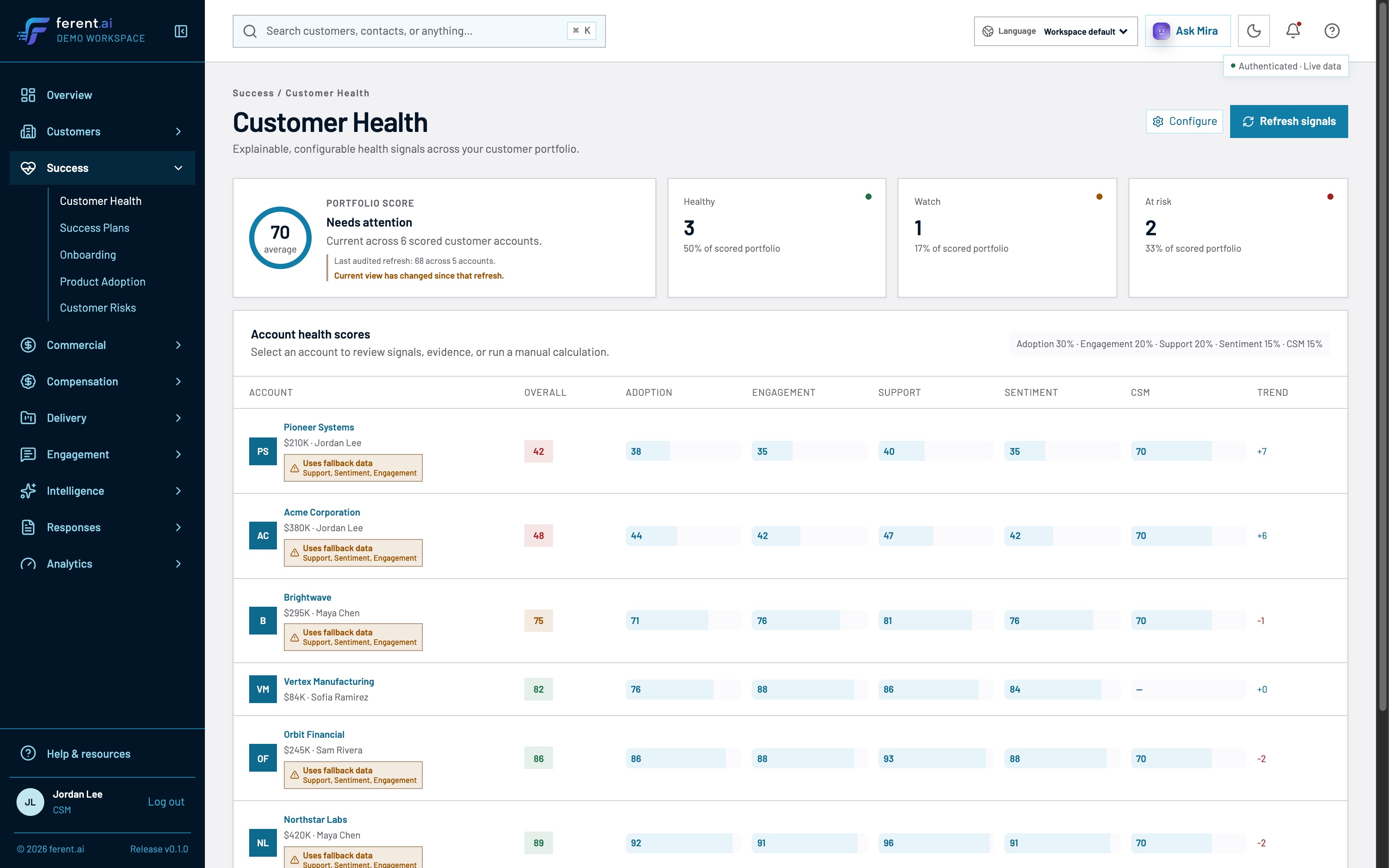
Two halves. Signals tells you which accounts are in trouble and why: health you can open up and check, churn predictions that name their model. Renewal Desk builds the offer from the lines you already hold, takes it to the customer with the calls on the record, and books the outcome: renewal, expansion, contraction or churn.
A future release for project delivery from the day the deal closes: plans, deliverables, change orders, time and margin, plus a portal your client will log into.
Portfolio runs on the Shared Platform: one customer record, four engines, Touchpoints and Mira. When Engagements ships it will run on the same one, so a project finishing there will move the health score here with nothing wired between them.
Start with whatever is worst.
Bring something real and we will work on it during the call: an account you are worried about, a forecast you do not trust, an onboarding that went badly. Forty-five minutes.